End homelessness? For me it’s personal.

Wise words from the leader of our sister project, the Faith & Family Homelessness Project. If we are to really transform the way we address family homelessness in our community, it needs to be personal for all of us.

Faith & Family Homelessness Project's avatarSeattle University School of Theology and Ministry's Faith & Family Homelessness Project

By Lisa Gustaveson, Faith & Family Homelessness Program Manager

553830_10200650804746093_599565699_n[1]In the spring of 2002 I was offered a six-month contract to manage the development of a local plan to end homelessness. I quickly accepted – I love project management and come on, the goal was to end homelessness!

Eighteen months and a ton of gray hairs later, I proudly stood by as the planning committee adopted a 57-page plan, A Roof Over Every Bed: Our Community’s Ten-Year Plan to End Homelessness in King County.

Many people don’t know or remember that the 10 Year Plan represents countless hours of research, meetings and then, more meetings. A broad coalition of people from local government, service providers, faith communities, advocacy organizations and people experiencing homelessness created the first Committee to End Homelessness (CEH) and the Staff Circle. Throughout the project hundreds of people offered ideas and suggestions at community meetings…

View original post 890 more words

Journalists Talk About Homelessness at Search for Meaning Book Festival

Kelley and Royale

Two award-winning journalists — featured speakers at the Search for Meaning Book Festival at Seattle University — will give an inside look at the challenges of reporting on homelessness during a special add-on session at the Festival.  “Coffee Talk with Tina Kelley and Rosette Royale” is Saturday, Feb. 28, 2:30 – 3:30 p.m. in Pigott 204.

Festival tickets are required for the keynotes and author sessions, but admission to this intimate conversation is free. The first people in line will receive a complimentary copy of Tina Kelley’s book (see below). Seattle U Communication students, Theology and Ministry students, homelessness advocates and Real Change vendors are encouraged to attend. The session is hosted by the Seattle University Center for Strategic Communications and the School of Theology and Ministry.

Did you know? Seattle University faculty, staff and students, as well as Real Change vendors, can attend the entire Festival for free.  If you are a student, please reserve your Festival tickets at student registration; faculty or staff members, visit faculty and staff registration. Real Change vendors should go to the Registration Tent to register and indicate that they are vendors (bring your badge). For all other community members, tickets to the festival can be purchased for $10.

It is Seattle University’s goal as an institution that cost should not prohibit attendance. If cost would directly prohibit your attendance of Search for Meaning 2015, please contact register@seattleu.edu.

About the Authors: Tina Kelley is a former New York Times, Seattle Times and Seattle Post-Intelligencer reporter, and co-author of the national best-seller about youth homelessness, “Almost Home: Helping Kids Move from Homelessness to Hope.” Rosette Royale is interim editor for Real Change and a Seattle University Journalism Fellow on Family Homelessness, and winner of the national Sigma Delta Chi Award in Feature Writing.

Remember to Come Early! The first 20 people to arrive at the “Coffee Talk” will get free copies of Almost Homewhich profiles six teens experiencing homelessness as they try to reach stability.

Learn more about these fantastic writers — and the other 50-plus authors — at the Festival author page.

About the Festival: Billed as one of Seattle University’s signature events, the Search for Meaning Book Festival is a campus-wide affair that explores what it is to be human, while emphasizing literature and speakers that align with Seattle University’s mission of creating a just and humane world. The festival has everything from books and book signings, to presentations and special sessions that explore topics in depth.

We hope to see you there!

To learn more about the festival, or to register, go here.  For more information about the Coffee Talk, please contact Lisa Gustaveson (gustavel@seattleu.edu) or Catherine Hinrichsen (hinrichc@seattleu.edu).

Richard Lemieux: Tent cities offer hope and help for the homeless

Faith & Family Homelessness Project's avatarSeattle University School of Theology and Ministry's Faith & Family Homelessness Project

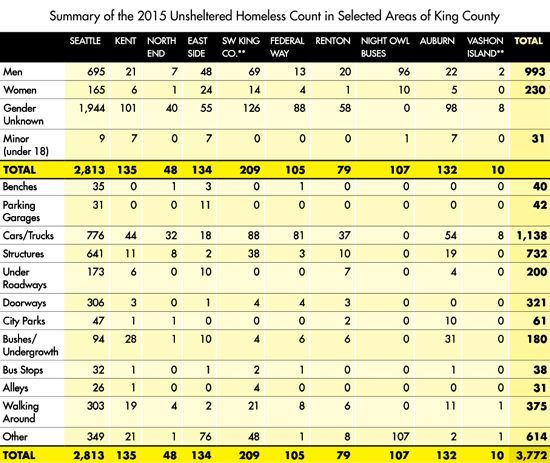
In the wake of the disheartening news that at least 3,772 people were unsheltered in King County in January 2015 ( as counted during the annual One Night Count on January 23rd), Mayor Ed Murray proposed that the City of Seattle allow and regulate three new tent cities in the city’s nonresidential areas. Since then, a flood of discussion about the plan’s merits and failings has ensued, as well as a more general discussion about the role of tent cities in solving the problem of homelessness in our region. Among these voices, Richard Lemieux offers a balanced and compassionate perspective on the positive but ultimately limited and transitional role he believes tent cities play in ending homelessness. Richard is a homeless survivor, advocate, motivational speaker, and author of Breakfast at Sally’s. Read his 2/7/15 Seattle Times editorial below.

Image: “Tent City” courtesy of KUOW 94.9 Public Radio, under a…

View original post 1,029 more words

From the Director of the Committee to End Homelessness in King County: Turn the One Night Count into Positive Momentum!

We’re re-posting this piece from our colleague Lisa Gustaveson at the Faith & Family Homelessness Project, who passes along an important perspective on this year’s One Night Count of Homelessness in King County. Neighboring counties will do their count later this week, and a lot of what Mark and Lisa say applies to those counties as well. Let’s turn our reaction to the numbers into action to make homelessness rare, brief and one time!

Lisa Gustaveson's avatarSeattle University School of Theology and Ministry's Faith & Family Homelessness Project

One Night Count 2015On or around January 23, 2015 most regions of the country – and every county in Washington State – completed local Point in Time Counts. These manual counts of people who are experiencing homelessness give us a snapshot of how the homeless system is performing. Last week King County reported a 21% increase in the number of people they found living in places not fit for human habitation. Clearly, we need to make changes to the way we are doing things to reach the outcomes needed  to make homelessness rare, brief and one time.
In press release, Alison Eisinger, Executive Director of the Seattle/King County Coalition on Homelessness, which organizes the count, reports a substantial increase over those found without shelter last year. “This year’s Count is heart-breaking evidence that we cannot cover our community’s most basic needs. Clearly, the crisis of people homeless and without shelter is growing, and clearly we…

View original post 785 more words

Firesteel Adds New StoryCorps Section to their Website

***This post is a repost from the Firesteel website

Introducing the New StoryCorps Section of Our Website!

Alexis Gaines and her case manager Tanya Mendenhall Mettlen participated in the StoryCorps "Finding Our Way" project. In a new audio story produced from their interview, Alexis talks about how she tried to create positive memories for her son, even as they experienced homelessness together. Image credit: StoryCorps
Alexis Gaines and her case manager Tanya Mendenhall Mettlen participated in the StoryCorps “Finding Our Way” project. In a new audio story produced from their interview, Alexis talks about how she tried to create positive memories for her son, even as they experienced homelessness together. Image credit: StoryCorps

Written by Denise Miller, Firesteel Advocacy Coordinator

A Tacoma mom remembers being evicted from her home, and looking for a tent for her family of five. A Seattle teenager describes the challenges of doing homework while living in a car. A South King County11-year-old reflects on losing friends when they learned she didn’t have a home. These are just a few of the stories captured by the StoryCorps “Finding Our Way: Puget Sound Stories About Family Homelessness” initiative last summer, and now featured on a new section of our website.

I’ve been talking about the “Finding Our Way” project for almost a year now. Last spring, as we began inviting people to sit down with a loved one and share how homelessness has affected them, I wrote about how personal stories can build bridges between people and drive social change. Over the summer, I shared some of the most moving moments from our recording days. At Thanksgiving, I posted gratitude for the brave men, women and children who participated in the project and gave permission for their stories to be used for advocacy.

Now it’s time to invite you to listen to and share audio clips produced from the recordings. Our new StoryCorps page currently features five short stories that help listeners understand how homelessness affects families in our community, and we’ll continue adding stories over coming months.

Read more at the Firesteel website here.

Learn more about the StoryCorps project. Continue reading

3rd Annual Social Media 101 for Housing Advocates Hangout, Jan. 27 – Register Now!

Social Media 101 photo
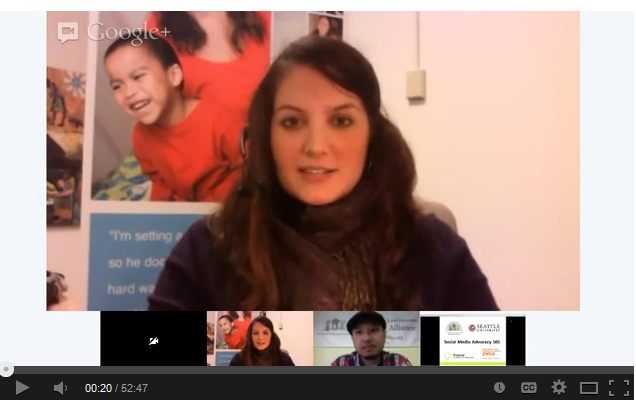
Erin Murphy of YWCA is one of the Hangout leaders; this is a screen shot from the first Hangout two years ago.


Effective use of social media is a great way to reach a target audience, and advocate for the issues you care about — like affordable housing and an end to homelessness.

So, join us on Tuesday, January 27 at 10:30 a.m. for our third annual “Social Media 101 for Housing Advocates” Hangout. Co-hosted with Firesteel and the Washington Low Income Housing Alliance, this will be a free training session for people who want to learn how to use social media to advocate online for affordable housing issues. The session will help you understand and use social media sites and apps like Twitter and Facebook, and show you how to join with organizations to be an online housing advocate.

There are two ways to access the training:

Option 1: Access Online By Yourself via Webinar

The organizers will be facilitating this workshop as a live Google Hangout video conference, running from 10:30-11:30 a.m. So, participants will be able to attend from anywhere they choose. Register now!

Option 2: Watch in a Room with Other Advocates

If you want a more hands-on approach, you can come to Seattle University’s Chardin Hall, room 145, to watch the live 45-minute webinar and exchange ideas and ask questions afterwards till about 12:30 p.m. Seattle U’s social media marketing specialist, Sarah Hyde, will be on hand to help us think through how we can use social media techniques to advocate year round. Coffee and snacks will be available. Please register by Friday, Jan. 23 for this option if you can.

Agenda for Option 2
10:30 – 11:30am      Video conference
11:30 – 12:30pm      Follow-up coaching and Q & A
Coffee and snacks will be provided. Please bring your own lunch.

We highly recommend that you bring your laptop and/or a mobile device with you, but it is not required. Paid parking is available on the street (12th Avenue is easiest) or in the Murphy garage.  There is also limited free two-hour parking in the streets east of the university. Please see this campus map for details on parking and room location.

Hope to see you there!

Learn to Hone Your Story About Family Homelessness with “The Moth”

121214_Tour_Ninelives_15 credit Roger Ho
The Moth training can help you hone your story. Photo credit: Roger Ho

Every story begins with an idea or an experience. But how do you take that and shape it into a compelling narrative?

The people at The Moth have it all figured out, and they’re coming to Seattle this February to conduct one of their acclaimed workshops on storytelling. The theme is “Home: Lost and Found,” and the stories will focus on family homelessness.

We’re looking for people who have a personal story related to family homelessness that they want to craft into a finely polished 5-minute gem that will captivate an audience. The workshop is free, but limited to 16 people..

We’re accepting applications now till Friday, Feb. 6, 2015. Apply now! Get more information on our project page. Good luck!

Picturing Child Homelessness: The Challenges Behind “The Big Brain”

Written by Perry Firth, project coordinator, Seattle University’s Project on Family Homelessness and school psychology graduate student

Editor’s Note: This is a re-post from our partners at Firesteel.

Image 1 Big Brain Excerpt

 Caption: Here is a portion of our new infographic, “The Big Brain.” If you want to see the rest of the infographic, keep reading! Image from the Project on Family Homelessness.

  In September, Seattle University students Perry Firth and Krista Kent created nine new infographics as part of our series, Poverty and Homelessness in the Public School System. The experience inspired them to create one super-infographic that they nicknamed “The Big Brain.” It took them three months. What are the perils of encapsulating so much information into one bold visualization? Perry takes us behind the scenes of creating this brand-new infographic, “Child Homelessness & Toxic Stress: Far-Reaching Consequences,” and shares some pointers for designers and writers who take on the challenges of conveying complex data.

 I once read somewhere that we have the attention span of goldfish.

Or, at least I think that’s what I read. I was scanning the article, so I could be wrong.

Jokes aside, there is no doubt that the Internet is shaping how information is conveyed, and interacted with. People are reading less. Yes, it’s true. And, in our Internet-saturated culture, our attention spans are also decreasing.

We start articles, but we don’t always finish them.

Where once people were more interested in in-depth analysis of a particular subject matter, now we scan contently quickly, picking out choice pieces of information.

This is something that the Project on Family Homelessness team is aware of. Therefore we have increasingly prioritized developing high-quality infographics (visual representations of information) – either on behalf of our partner organizations or for our own content – as a way to convey our messaging without overwhelming our audience.

And no, the irony is not lost on me that I am writing something that requires reading, about how people aren’t reading. Ha!

Image 2 Perry Firth

Caption: Hi! My name is Perry. I enjoy writing long pieces around the need to write less. Photo courtesy of Perry Firth. Continue reading

Local Story Behind Debut of “@home” on Chicago PBS Station

Photo Tiana Haley @home t-shirts
Seattle U students Haley Lewis (L) and Tiana Quitugua (R) model their new t-shirts featuring the artwork Haley created for “@home.” Photo by Catherine Hinrichsen.

Tomorrow night, a powerful new documentary will have its broadcast premiere, on Chicago’s WTTW-TV, Channel 11 (PBS), 9 p.m. Central. So, this is a great time to reflect on one of the highlights of our year: hosting the remarkable e-activist Mark Horvath for the Seattle premiere of the film about him, “@home.”

We were thrilled to bring Mark and the film’s director, Susanne Suffredin, here in May for the premiere, which kicked off another highlight of our year, the Hack to End Homelessness.

Watching the film in prep for the screening, our student Haley Jo Lewis was inspired to create an illustration about Mark. The film’s producers, the Kindling Group, liked the art so much that they used it to print t-shirts for their outreach campaign. The shirts arrived last week! Haley and our project assistant and recent SU grad, Tiana Quitugua, were happy to model the shirts; see the photo above.

@ home drawing, Haley Lewis, @hardlynormal
Haley tweeted her illustration at Mark in April, and he took notice!

Continue reading

Washington Youth and Families Fund: Making Homeless Rare, Brief, One-Time

WYFF image family

Seattle University will join Washington Gov. Jay Inslee, First Lady Trudi Inslee and nearly 40 different partner organizations today in a pledge to make family and youth homelessness rare, brief and one-time in our state by 2020.

It’s part of a celebration of the Washington Youth & Families Fund (WYFF). The fund is expanding its focus to embrace youth and young adults, building on 10 years of groundbreaking collaboration that is improving how homeless families and youth are served.

Seattle University’s President Stephen V. Sundborg, S.J., will be one of the signatories on the WYFF Memorandum of Understanding to be signed by business, government and community leaders today.

PresidentSundborg-2013
Seattle University President Stephen V. Sundborg, S.J., joins dignitaries signing the pledge to make family and youth homelessness rare, brief and one-time.

“Education is a critical piece of the puzzle in addressing homelessness. We believe every child deserves a place to call home, yet more than 30,000 school-aged children in Washington state – from kindergarten through high school – were reported as homeless in 2012-2013,” Fr. Sundborg said. “These children and their families need support to keep the children in school and to help the families succeed. The Washington Youth & Families Fund has been providing that support since 2004, and is an important investment in the future of the families in our state.”

The fund, established in 2004 by the Washington State Legislature and managed by Building Changes, is a unique partnership among funders, governments and service providers to share solutions and streamline resources for homeless youth and families.

Our project is proud to be one of the many Seattle University initiatives working to fight homelessness and poverty, and to join partners across the state in working to make family and youth homelessness rare, brief and one-time..