This is a re-post of an article published on Firesteel’s blog Aug. 22, 2014.
In a StoryCorps conversation that aired on NPR this morning, a student talks with her mom about attending high school while living in a car. Image from StoryCorps.
Written by Denise Miller, Firesteel Advocacy Coordinator
In a heart-wrenching story that aired on NPR this morning, one of these students talks about the challenges of attending high school while living in a car with her family. [Note – in April 2025, a family member requested the story be removed because circumstances have changed, and we are honoring that request.]
The story was collected as part of the Gates Foundation’s “Finding Our Way” initiative, which has given more than 150 people in King, Pierce and Snohomish counties a chance to share in their own words how homelessness has affected their lives.
Written by Krista Kent, Digital Design Assistant, Seattle University Project on Family Homelessness and senior at Seattle U
As a child I always loved buying new school supplies, and there was perhaps nothing better than a brand-new case of Crayola markers. Having worked in a first-grade classroom this past year, I have seen that students are still excited to have new supplies. But for families who can’t afford to buy supplies, local supply drives play an important role in the community.
Recently I had the opportunity to participate in Project Cool for Back to School, which gathers supplies and creates backpacks for local school-aged children who are homeless. Volunteers came together at Columbia City Church of Hope earlier this month to help assemble and pack backpacks full of school supplies and dental kits.
Presented by the Seattle/King County Coalition on Homelessness, Project Cool prepared more than 1,300 backpacks with the help of 130 volunteers over the course of five days. The backpacks will be distributed to nonprofit organizations in August, just in time to get them to students all over King County.
Behind the scenes of a major effort
When I first arrived, I signed in, created a nametag, and then was led downstairs to where all the supplies were set up. There were big signs clearly marking where each station was located, including a first-aid station and a table set with coffee and donuts; it was clear that Project Cool really appreciates their volunteers.
During introductions I learned that there were volunteers from differing backgrounds: staff from the Salvation Army, YWCA, YMCA, even students who are currently in the youth program at the YMCA. Regardless of whether this was our first or fifth year with Project Cool, we all arrived with the same intention of making sure that every student comes to class with school supplies.
After introductions, the 11 of us split into groups and set off to different stations. Some prepared dental kits, some took out the recycling, and others cut ribbon that would be used to mark backpacks ready for distribution. For the two hours that I was there, I removed the plastic encasing from the backpacks and took out the small silicone sanitary packs that were inside.
We’ve just said some sad good-byes to most of our team members on the Project on Family Homelessness, but we welcome several great additions to our team. Here’s who will be impressing you in the months to come, and a reflection on some of the outstanding work of our former team members.
New Project Assistants: Krista Kent and Emma Lytle
Krista Kent is a senior in the Digital Design program, minoring in Spanish. She’ll be our new design assistant, taking over for McKenna Haley (see below).
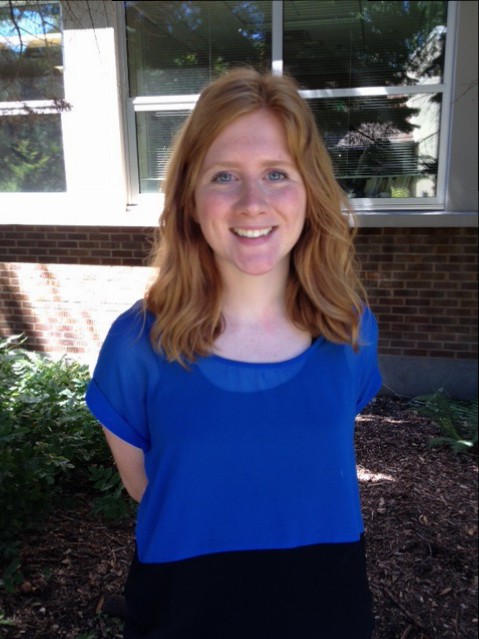
Krista Kent joins our team as digital designer.
Krista comes to us with a strong background in design and active involvement in the community. Since winter of 2012, Krista has worked with Seattle University’s Center for Service and Community Engagement. She created flyers and informational design for the Center, and has worked at Bailey-Gatzert Elementary assisting teachers in classrooms and helping first graders in an afterschool-tutoring program. Recently Krista had the opportunity to re-brand First Cup Coffee House into Mama’s Café, as part of the 23rd and Union Small Business Consultation and Community Enhancement Project.
Emma Lytle is our new project assistant, replacing Tiana Quitugua, who just graduated (see below).
Emma (left) at the American Refugees photo booth hosted by Firesteel; she’s posing with Jediah McCourt.
Emma is entering her senior year as a strategic communications major at Seattle University. She joins us with a passion for working with non-profits and with children. She recently finished a seven-month internship with the Make-A-Wish Foundation, where she handled sensitive communication with families and healthcare professionals. Emma also worked for several years as a daycare teacher and loves working with children and families. Some of our partners might remember Emma from her enthusiastic volunteer work and professionalism at the Hack to End Homelessness and the SIFF American Refugees premiere. She’s busy working on outreach for the StoryCorps project.
New Grad Assistant/Project Coordinator: Perry Firth
We’re happy to welcome back Perry Firth, in an expanded role as half-time Project Coordinator, taking over for Graham Pruss (see below).
Perry Firth returns in an expanded role.
Perry is continuing her graduate work at Seattle U in school psychology and spent the past school year as a research assistant to a visiting scholar and counseling psychologist. Their work together focused on prevention and wellness, ecological counseling, and toward the end of their time together, school shootings. That position ended just as we needed to fill our position — lucky us! Perry is committed to approaching mental health issues through a social justice lens, and has a special interest in anxiety disorders, adolescence, and issues that disproportionately impact women. She is a gifted writer who is especially adept at analyzing the intersection between academic research and its applications to family homelessness, just as she did in these Firesteel posts on Adverse Childhood Experiences (ACEs) and the all-time most-viewed Firesteel post, on dehumanization, “Why We Keep Walking.” We’ll be looking for her to help us understand more about the important links between housing and academic achievement for children in our state.
What was the role of Seattle University faculty, students and staff in the Hack to End Homelessness? They were planners, community liaisons, hackers and volunteers. This awesome new video by our project assistant, Tiana Quitugua, tells the stories of the many folks in red at the Hackathon.
Tiana is one of the stellar Seattle U students graduating this weekend, and this is one of her final projects for us. Thank you, Tiana, for capturing this experience and telling it from the SU perspective, and for all your great work for us.
NOTE: This blog post is about our StoryCorps project launch. For more recent information, see our StoryCorps page.
One of the most memorable StoryCorps segments for the family homelessness community is the story of Tierra Jackson, who with her former principal John Horan reflected on what it was like to be homeless in high school. Photo credit: StoryCorps.
Every Friday morning at around 7:30 a.m., millions of people around the country are entranced by a weekly public radio segment in which everyday Americans tell the stories of their lives. It’s the beloved StoryCorps, and it’s coming to our region in summer 2014 to find stories about families who have experienced homelessness.
While only about 50 of its stories per year make it onto National Public Radio, StoryCorps has actually recorded more than 50,000 stories in its 10 years. The stories are archived in the Library of Congress.
This July and August, people in Western Washington who have experienced family homelessness will be able to tell their own stories as part of the new StoryCorps project, “Finding Our Way: Puget Sound Stories about Family Homelessness.” The project is funded by a grant from the Bill & Melinda Gates Foundation, who asked our Project on Family Homelessness to serve as the local coordinator.
We’ll be working with local host partners to find stories from among their current and recent clients, and also reaching out to the public to find people who have experienced family homelessness in their past. The stories will also be available for our advocacy efforts to end family homelessness in Washington state.
Find out how service providers can help us find the stories and use them to advocate. Got a story? Click to jump to the details.
Seattle University, four animated shorts, and a determination to change the way people see family homelessness
Written by Haley Jo Lewis, Student Project Assistant for the Seattle University Project on Family Homelessness
Seattle University: empowering leaders for a just and humane world. But what does that really look like?
It was a sold-out show on May 19 at the Harvard Exit theatre. While a sold-out show is not necessarily unusual, the content of the films made it remarkable. The films, titled collectively as American Refugees, are four animated shorts that tell the stories of families, homelessness and their resilience against all odds.
Marquee at the Harvard Exit theatre. Photo by Steve Schimmelman.
Seattle University’s Film and Family Homelessness Project had recruited five professional filmmakers to create these films. Seattle University students were involved throughout the process — assisting the filmmakers as Student Fellows, helping to develop discussion guides, designing collateral and finally, volunteering at the event itself.
More from inside the Hackathon! Our partners at Firesteel have documented their Hack to End Homelessness experience in this great blog post. It describes Erin’s experiences working on the “Maptastics” super-team, features one of Denise Miller’s trademark awesome videos about the weekend and also includes an interview with our special guest, Mark Horvath.
Would you even think to wish for a home? Maybe a bigger one, perhaps, if you already have one.
While interviewing people who are homeless, social media pioneer and homelessness advocate Mark Horvath always ends his conversations with a question: “If you had three wishes, what would they be?”
In the new documentary about him, “@home,” the people Mark interviews, without fail, wish for a home.




 projectonfamilyhomelessness.org