Invisible Families — Five Years After the Landmark Seattle Times Series on Family Homelessness

Seattle Times 29 Aug 2010 Front PageBy Catherine Hinrichsen, project manager, Seattle University Project on Family Homelessness

The crashing ocean waves were the score to my quest on a Saturday night five years ago, at a quiet seaside housing development on the Washington coast. I excused myself from our little multi-family gathering around 10 p.m. to go stake out the central office, in search of an Internet connection. Though it was after hours and the building was closed, the wifi was still on. I lugged my heavy, ancient laptop to a pillar with a ledge and propped it up, typing into the search bar “www.seattletimes.com”… Would it be there? And what would it say? Continue reading

Trauma-Informed Care, StoryCorps, and Host Homes for Youth: Some Highlights From WLIHA’s Conference on Ending Homelessness

Written by Perry Firth, project coordinator, Seattle University’s Project on Family Homelessness and school psychology graduate student

 image 1conference

Caption: This image captures just how many people attended WLIHA’s Conference on Ending Homelessness. As you can see, we were a big crowd! Image from WLIHA.

 This year I had the pleasure of attending the Washington Low Income Housing Alliance’s Conference on Ending Homelessness in Tacoma, May 13-14. I was there with over 800 people (the largest turnout yet), all devoted to making homelessness rare, brief and one time.

There were many highlights, including Firesteel’s presentation on StoryCorps and strategic communications, the Project on Family Homelessness’s “Dessert Dash” and StoryCorps workshop, and the sessions on host homes for homeless youth and trauma-informed care.

Firesteel shows how StoryCorps can be a valuable communication tool

I loved Firesteel’s presentation on StoryCorps and strategic communications. As part of the Project on Family Homelessness, I have had the honor of helping the StoryCorps effort reach its full potential. As the Firesteel team and Joaquin of WLIHA discussed StoryCorps’ many uses and the role of strategic communications in ending homelessness, I was reminded of how many lives this project has touched.

This was further emphasized to me when our own team hosted a workshop and “Dessert Dash” with Sherry and Franklin Gilliard—a family whose courage in the face of home loss and homelessness was profiled on NPR’s Friday StoryCorps segment this past November. Continue reading

Firesteel Adds New StoryCorps Section to their Website

***This post is a repost from the Firesteel website

Introducing the New StoryCorps Section of Our Website!

Alexis Gaines and her case manager Tanya Mendenhall Mettlen participated in the StoryCorps "Finding Our Way" project. In a new audio story produced from their interview, Alexis talks about how she tried to create positive memories for her son, even as they experienced homelessness together. Image credit: StoryCorps
Alexis Gaines and her case manager Tanya Mendenhall Mettlen participated in the StoryCorps “Finding Our Way” project. In a new audio story produced from their interview, Alexis talks about how she tried to create positive memories for her son, even as they experienced homelessness together. Image credit: StoryCorps

Written by Denise Miller, Firesteel Advocacy Coordinator

A Tacoma mom remembers being evicted from her home, and looking for a tent for her family of five. A Seattle teenager describes the challenges of doing homework while living in a car. A South King County11-year-old reflects on losing friends when they learned she didn’t have a home. These are just a few of the stories captured by the StoryCorps “Finding Our Way: Puget Sound Stories About Family Homelessness” initiative last summer, and now featured on a new section of our website.

I’ve been talking about the “Finding Our Way” project for almost a year now. Last spring, as we began inviting people to sit down with a loved one and share how homelessness has affected them, I wrote about how personal stories can build bridges between people and drive social change. Over the summer, I shared some of the most moving moments from our recording days. At Thanksgiving, I posted gratitude for the brave men, women and children who participated in the project and gave permission for their stories to be used for advocacy.

Now it’s time to invite you to listen to and share audio clips produced from the recordings. Our new StoryCorps page currently features five short stories that help listeners understand how homelessness affects families in our community, and we’ll continue adding stories over coming months.

Read more at the Firesteel website here.

Learn more about the StoryCorps project. Continue reading

Picturing Child Homelessness: The Challenges Behind “The Big Brain”

Written by Perry Firth, project coordinator, Seattle University’s Project on Family Homelessness and school psychology graduate student

Editor’s Note: This is a re-post from our partners at Firesteel.
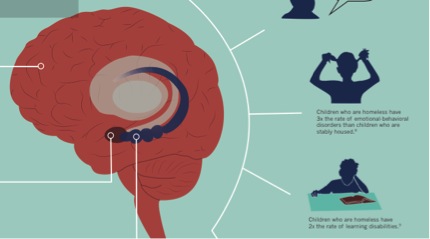
Image 1 Big Brain Excerpt

 Caption: Here is a portion of our new infographic, “The Big Brain.” If you want to see the rest of the infographic, keep reading! Image from the Project on Family Homelessness.

  In September, Seattle University students Perry Firth and Krista Kent created nine new infographics as part of our series, Poverty and Homelessness in the Public School System. The experience inspired them to create one super-infographic that they nicknamed “The Big Brain.” It took them three months. What are the perils of encapsulating so much information into one bold visualization? Perry takes us behind the scenes of creating this brand-new infographic, “Child Homelessness & Toxic Stress: Far-Reaching Consequences,” and shares some pointers for designers and writers who take on the challenges of conveying complex data.

 I once read somewhere that we have the attention span of goldfish.

Or, at least I think that’s what I read. I was scanning the article, so I could be wrong.

Jokes aside, there is no doubt that the Internet is shaping how information is conveyed, and interacted with. People are reading less. Yes, it’s true. And, in our Internet-saturated culture, our attention spans are also decreasing.

We start articles, but we don’t always finish them.

Where once people were more interested in in-depth analysis of a particular subject matter, now we scan contently quickly, picking out choice pieces of information.

This is something that the Project on Family Homelessness team is aware of. Therefore we have increasingly prioritized developing high-quality infographics (visual representations of information) – either on behalf of our partner organizations or for our own content – as a way to convey our messaging without overwhelming our audience.

And no, the irony is not lost on me that I am writing something that requires reading, about how people aren’t reading. Ha!
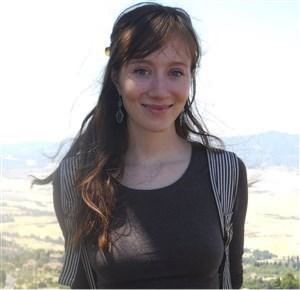
Image 2 Perry Firth

Caption: Hi! My name is Perry. I enjoy writing long pieces around the need to write less. Photo courtesy of Perry Firth. Continue reading

Moving Hearts, Changing Minds About Homeless Students: NAEHCY’s Annual Conference

By Perry Firth, project coordinator, Seattle University’s Project on Family Homelessness and school psychology graduate student

Paving the way image 1 

Caption: This poster from the conference just about sums it up: all children, including those who are homeless, deserve equal access to educational opportunity. Image from NAEHCY.org

As a first-time attendee at the National Association for the Education of Homeless Children and Youth (NAECHY) annual conference in Kansas City, October 25-28, I wasn’t quite sure what to expect.

But the opportunity to learn about where the field of “homeless education” is going, and what that might mean for the work we do on the Project on Family Homelessness, was just too exciting and important to miss.

It turns out my premonition was correct. The conference sparked ideas that I was able to apply very soon after my return, in a discussion about a local school district that is struggling to support its children who are homeless. Continue reading

“Goodness, Resilience and Love”: Formerly Homeless Tacoma Family on StoryCorps Friday, 11/28

StoryCorps Gilliard Family-official version

Franklin and Sherry Gilliard, the Tacoma family whose story aired on StoryCorps Nov. 28.

We’re feeling grateful for the bounty of heartfelt stories that Puget Sound families told StoryCorps this summer, and amazingly, a second story from our project has been selected for national broadcast.  The story aired Friday morning, Nov. 28 during StoryCorps’ “National Day of Listening” on National Public Radio’s Morning Edition.

The story was recorded as part of our project, “Finding Our Way: Puget Sound Stories About Family Homelessness.” “Finding Our Way,” funded by the Bill & Melinda Gates Foundation, is a collaboration between Catholic Community Services of Western Washington (CCS), YWCA Seattle | King | Snohomish and Seattle University Project on Family Homelessness.

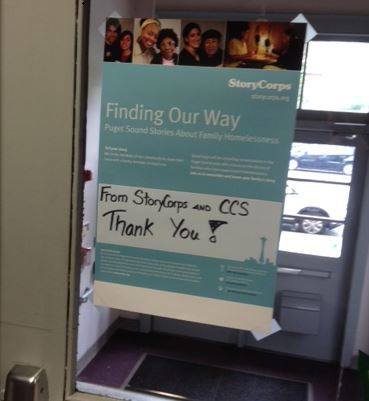
StoryCorps Tacoma sign on door
The Gilliard family first recorded their story at CCS in July. Here’s the “farewell and thanks” sign that CCS staff posted on their front door that week.

The story, “Once Homeless, Family Feels ‘Blessed To Wake Up Another Day,'” features the Gilliard family of Tacoma, Wash., who first recorded their story at CCS in July. StoryCorps producer Eve Claxton heard their story and invited them back for an additional recording in early November, also at CCS, and from that recording the story was produced. Here’s the official description of the story:

Sherry Gilliard talks with her husband Franklin Gilliard about losing their business and subsequently their home after the economic crash, their experience of becoming homeless and living in a shelter with their three children, and the love and faith that brought them through these hardships. The family is now in transitional housing in Tacoma, Wash.

“Friday is our ‘National Day of Listening,’ and for that broadcast we always try to air pieces that embody goodness, resilience and love,” Eve said. “The Gilliards are a very special family and everyone here is excited to share their story on such a special day.”

Continue reading

New Infographics on Childhood Homelessness, Education, and Child Development

Like Infographics? Interested in visual representations of some of the issues that can accompany childhood homelessness and poverty? Then take a peek at the infographics we recently created for our seven-part series, “Homelessness and Poverty in the Public Education System.”

Learn more by reading the series on Firesteel’s website here

We are always interested in how homelessness, poverty and stress affect child development and adult outcomes. Recent research into these relationships for our seven-part series “Homelessness and Poverty in the Public Education System” yielded not only great insights, but, thanks to the talents of our digital designer Krista Kent, nine new infographics. Continue reading

Homelessness and Poverty in the Public Education System: An Intro to Our Blog Series

This is a re-post from our partner, Firesteel, from Sept. 2, 2014.  This week, Firesteel began publishing an insightful seven-part series on homelessness in the classroom, written by our project coordinator, Perry Firth. Homelessness affects more than 30,000 school-age children in Washington state.
The series also includes brand-new infographics, designed by our digital design assistant, Krista Kent (see below). Read and share!

Children know when they are falling behind academically. As they continue to struggle, they can develop both low self esteem and a dislike of school. That is why it is so essential that children who need extra help get it.<br /><br /><br /><br /><br /><br /><br /><br /><br /><br /><br /><br />
Image from pixabay.com.


Children know when they are falling behind academically. As they continue to struggle, they can develop both low self esteem and a dislike of school. That is why it is so essential that children who need extra help get it. Image from pixabay.com.

As the new school year starts, teachers face many challenges. So do children who are dealing with homelessness and poverty. And this couldn’t be truer than for impoverished children who are also in need of special education services. With parents focusing on day-to-day survival and too busy to consistently advocate for their needs, children who are homeless may fail to receive the services they need to succeed in school.

The result is that children already harmed by their living circumstances can fall even further behind. Therefore, adults who work with children in poverty and homelessness need to understand how this environment influences academic skill and emotional development, and how it relates to special education needs.

So, we present this seven-part series on how homelessness and poverty affect the development of children, and how this can show up in the education system. Thanks to Perry Firth for contributing this important series.

Read the full post here and follow the seven-part series on Firesteel.

Also, check out these new infographics created for the series by our digital design assistant, Krista Kent. 


Continue reading

As Heard on NPR: Homelessness Threatens Student Success

This is a re-post of an article published on Firesteel’s blog Aug. 22, 2014.

In a StoryCorps conversation that aired on NPR this morning, a student talks with her mom about attending high school while living in a car. Image from StoryCorps.

Written by Denise Miller, Firesteel Advocacy Coordinator

More than 30,000 schoolchildren in Washington state are experiencing homelessness.

In a heart-wrenching story that aired on NPR this morning, one of these students talks about the challenges of attending high school while living in a car with her family. [Note – in April 2025, a family member requested the story be removed because circumstances have changed, and we are honoring that request.]

The story was collected as part of the Gates Foundation’s “Finding Our Way” initiative, which has given more than 150 people in King, Pierce and Snohomish counties a chance to share in their own words how homelessness has affected their lives.

Read This Post in Full.

See More about our StoryCorps Project.

The Smiths — The Film About Homelessness That Had To Be Made

A new animated film about family homelessness and helping neighbors 

By Lisa Gustaveson, Project Manager for Seattle University’s Faith & Family Homelessness Project

http://https://www.youtube.com/watch?v=53PvBKXPghM

As program manager for Seattle University’s Faith & Family Homelessness Project, I spend much of my time visiting local emergency shelters, churches, synagogues and mosques. During my visits, I often meet dedicated volunteers who spend countless hours providing meals, collecting clothes, back to school supplies, and hygiene items, for people experiencing homelessness (you all know who you are!).

During these visits, the question I am most frequently asked by volunteers is, does any of this make a difference? They wonder if they really are helping to end family homelessness.

It’s easy to feel overwhelmed and unappreciated when the number of homeless families seems to grow every day. It’s also hard to find the best way to describe the importance of each and every act of kindness, how all those little gestures make a difference.

That’s why I was so excited when I learned about filmmaker Neely Goniodsky’s plans to create the short animated film, “The Smiths,” as part of Seattle University’s Film and Family Homelessness Project.

“The Smiths” is one of four short films created through the project, collectively titled “American Refugees.”


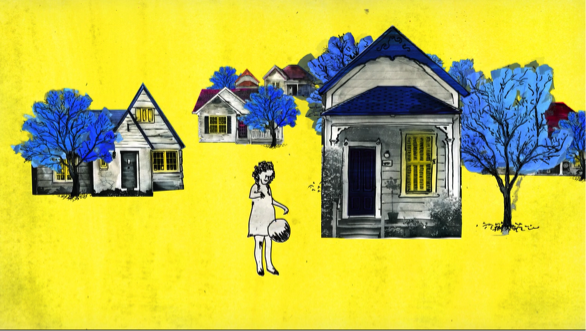
The Smiths American refugees

A still from the film “The Smiths.” The vivid colors used throughout the film convey the intense emotions of a family who is homeless, as they try to make ends meet.

I was a member of the project’s advisory team, so I had the opportunity to read the proposal by Neely Goniodsky. As I read it, I knew that the film should be – no, HAD to be – made.

Continue reading