Behind the Scenes: Visualizing Data About Student Homelessness

By Mandy Rusch, Digital Design Project Assistant, Project on Family Homelessness

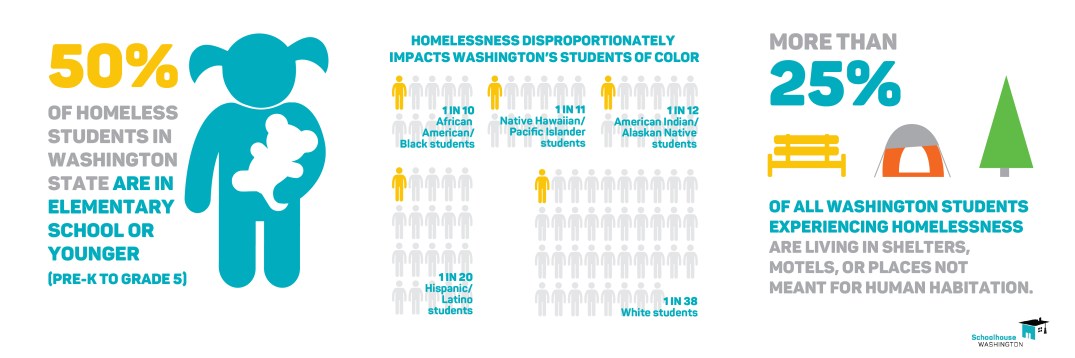
This past winter, Schoolhouse Washington approached us with an exciting new project: to create visualized data graphics for use in their communication materials. In this post, I will describe my approach and learning process over the course of the project, which taught me a lot about what it takes to develop advocacy tools.

Schoolhouse Washington is a partnership between Building Changes and Columbia Legal Services. The organization was formed because these two partners wanted to get more directly involved in advocacy to improve housing stability and advance educational success for the nearly 40,000 students in our state who experience homelessness.

One important way that Schoolhouse Washington advocates is through the use of data. They analyze the student homelessness data provided by the Office of the Superintendent of Public Instruction, which is important to share because it helps describe needs to lawmakers and policymakers.

Graphic data visualizations, or “infographics,” are an incredibly powerful way to share data like this. The use of images and charts to show data visually helps to tell a clear message that is easier for viewers to digest than a written document alone. Continue reading

“One Voice” — Housing and Homelessness Advocacy Day Through the Eyes of a First-Time Advocate

By Shan Yonamine, Project Assistant, Project on Family Homelessness

Going into my first Housing and Homelessness Advocacy Day (HHAD), I couldn’t help but feel a little nervous about calling myself a “housing advocate.” As a project assistant, I have created content that can be used as tools for advocacy and I have attended advocacy events, but I was afraid that I had not done enough advocacy to be an effective participant at HHAD. After participating in #HHAD2017, I realized that I could not have been more wrong.

In this blog post, I will recount my experience attending HHAD as a first-time advocate and explain how it changed my perception of what it means to be an advocate. Continue reading

Get Online and Advocate on Social Media Day of Action, Jan. 31

Note: This is an updated version of a post that originally ran on Firesteel in January 2016.


Use your social media skills to advocate for affordable housing and an end to homelessness on the fourth annual Social Media Day of Action, Tuesday, Jan. 31, 2017.

Advocates around the state will flock to Facebook, Twitter and other social media platforms that day to build an online movement as we lead up to Housing & Homelessness Advocacy Day (HHAD) in Olympia, Thursday, Feb. 2. HHAD is hosted by our partner, Washington Low Income Housing Alliance.

Continue reading

“Seeing Is Active” — A Collection of Memorable Quotes from “Streetwise Revisited”

By Shan Yonamine, Project Assistant, Seattle University Project on Family Homelessness

lead-image-collection-of-quotes


Introduction – This project and my purpose

It has been over two weeks since the “Streetwise Revisited” exhibit at The Seattle Public Library  has closed, and I am still finding myself thinking about the project and reflecting on my experiences. I find myself torn between wishing that it wasn’t over, and feeling so grateful that it happened that I decided to reflect on it even further.

“Streetwise Revisited” was The Seattle Public Library’s public education program focused on “Streetwise,” the 1984 documentary film, and the 30-year collection of photos by the renowned documentary photographer Mary Ellen Mark. It consisted of a range of events from history talks to film screenings, and involved many important advocacy organizations that are also working to end homelessness.

Because the Seattle University Project on Family Homelessness  was a community partner, I took the opportunity to attend as many of the “Streetwise Revisited” events as possible and I’m so glad that I did. The project provided me with an overwhelming amount of insight on “Streetwise” and how it can be used as a tool for advocacy. I heard the perspectives of many individuals who either had a role in the original film or who are working today to advocate for people who are experiencing homelessness. More importantly, I realized that, as advocates, we are all powerfully connected by our cause.

Continue reading

“Create Change” — A Day to Change How We Think about Art, Advocacy and Homelessness

By Mandy Rusch, Digital Design Project Assistant, Project on Family Homelessness

Art is my coping mechanism. During the artistic process, there is power in the hands of the maker. Regardless of whether anyone sees the result or even if it is “good,” this power is healing, inspiring and uplifting.

At The Seattle Public Library’s “Create Change: Youth & Family Homelessness and the Arts” event on Oct. 29, 2016, I had the opportunity to come together with a community of people to find out how art can be used to take action towards ending youth and family homelessness. You can see an in-depth description of the full day of performances, speakers and arts events here in this story by my colleague Shan.

Continue reading

Mothers, Daughters, Conflict — The New “Tiny” Movie Hits Home


Editor’s Note: As part of our ongoing “Streetwise Revisited” work, our student project assistants are blogging about key events. Both Khadija and Shan wrote about the “TINY” screening, first Shan and now Khadija.

By Khadija Diallo, Project Assistant, Project on Family Homelessness

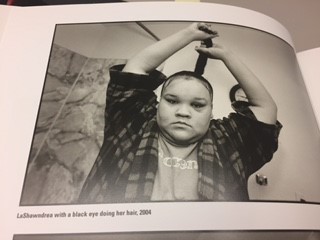
khadija-tiny-screening-black-eye
“LaShawndrea with a black eye doing her hair,” the photo that struck me most. Credit:  Photo I took of the photo by Mary Ellen Mark from the book “Streetwise Revisited.”


There’s a teenage girl with a black eye in photographer Mary Ellen Mark’s book “Tiny: Streetwise Revisited.” She is LaShawndrea, the eldest daughter of Erin “Tiny” Blackwell. Of all the remarkable photos in that book, this one really struck me.

When I saw the film “TINY: The Life of Erin Blackwell” on Oct. 14, 2016 at the Seattle Public Library, it was LaShawndrea again who intrigued me the most. I sympathized with her because of a scene where she complains that Erin was not there for her. “She’s rejected me a lot,” narrates LaShawndrea.

I related to that scene because it reminded me of the strained relationship between my mother and grandmother; I have heard my mother make a similar remark about my grandmother which was one main reason LaShawndrea resonated with me. I can understand how it hurts to not feel true love from your mother. It seems the rejection from her mother has impacted LaShawndrea into her adult life.

The screening of “TINY” was part of The Seattle Public Library’s  public education program, “Streetwise Revisited,” which focused on “Tiny” from the 1984 documentary film “Streetwise.” Our project was a community partner, and we participated by screening the original “Streetwise” film, among other activities. (You can read my post about “Streetwise” and our guest, Erin’s daughter Keanna, here.)

Continue reading

“The Uncomfortable Conversation” — Using “Streetwise” as a Tool for Advocacy

Editor’s Note: As part of our ongoing “Streetwise Revisited” work, our student project assistants are blogging about key events. Both Khadija and Shan wrote about the “Streetwise” screening, first Khadija and now Shan.

By Shan Yonamine, Project Assistant, Seattle University Project on Family Homelessness


streetwise-campus-screening-poster
Poster for our campus screening of “Streetwise,” designed by Amy Phung.


“It didn’t change anything for us then,” said Erin “Tiny” Blackwell’s daughter Keanna Pickett about the impact of the documentary “Streetwise” on her family. “When people watch it, it’s a movie. You’re able to go about your life after you watch it.” In other words, Keanna was able to remove herself emotionally because the film can elicit powerful emotions that may be uncomfortable to deal with.

However, when “Tiny’s” daughter tells you that “Streetwise” should be used as the catalyst for an “uncomfortable conversation” about family and youth homelessness, you listen. Continue reading

The Fight for Her Life — “Streetwise” and Keanna’s Triumphant Story

Editor’s Note: As part of our ongoing “Streetwise Revisited” work, our student project assistants are blogging about key events. Both Khadija and Shan wrote about the “Streetwise” screening; here’s how Khadija saw it.

By Khadija Diallo, project assistant, Seattle University Project on Family Homelessness 


keanna-pickett-1
Keanna Pickett, educator, photographer, social justice activist and daughter of Erin “Tiny” Blackwell.

Keanna Pickett said that she “had to fight for her life from her first breath.”

When Keanna said that at our campus screening of the film “Streetwise” Oct. 7, it  stuck with me, because most of us fight to succeed and make something of our lives. But for Keanna, that quote had more meaning — because she said her mother, Erin “Tiny” Blackwell, while pregnant with her, did “every possible drug” to try to kill her in the womb.

That sort of revelation from her mother could have possibly caused a permanent rift in their relationship. Apparently it didn’t, because Keanna seemed  perfectly comfortable talking about her difficult upbringing. Continue reading

Three Years After Inocente — Overcoming Homelessness Through Art


Editor’s Note: This week is the third anniversary of Inocente’s visit to Seattle. We asked our new team member, Khadija, to watch the documentary “Inocente” and reflect on how it relates to our current work. 

By Khadija Diallo, Project Assistant, Seattle University Project on Family Homelessness

I had heard about Inocente’s story before, but this was my first time watching her documentary from beginning to end. Although homelessness is a dark and devastating situation for most people experiencing it, I was taken back by the multitude of colors that are shown throughout this Academy Award-winning documentary. These bright colors represented through her art, and through imagery, show the optimism and dedication that drives Inocente to continue to hope and dream for a better tomorrow.

“Inocente” tells the story of a 15-year-old girl experiencing homelessness but finding a will to live through her art. Her story is heartbreaking but also uplifting. At the beginning of the documentary, Inocente says “when I paint, I feel happy. It’s a good way to start my mornings.” And that’s how Inocente starts every morning, by painting what she dreams and what she hopes for her future.

inocente-painting
Inocente at work painting in the film. Credit: Sean Fine.

Continue reading

The “Lunch Ladies,” And Other Islands of Calm in a Choppy Sea


As First Place School weathers another storm, dedicated staff and volunteers keep things afloat

By Catherine Hinrichsen, Project Director, Seattle University’s Project on Family Homelessness

wube-worku_first-place_snip2
The very picture of serenity: Wube Worku of First Place School.

Last Friday, five days before school was scheduled to start, the halls of First Place School were fairly quiet.  In the classrooms of this school in Seattle’s Central District, brightly colored new backpacks stuffed with supplies were neatly lined up in the classroom cubbies. Volunteers like me from Seattle University‘s day of service were sprucing up the lunchroom bulletin boards and moving unneeded furniture into storage. In the kitchen, the “lunch lady,” Wube Worku, chopped vegetables and prepped the counters, pots and pans for a busy school year.

It all seemed cheerful and calm; but under the surface there was tension. Only days before, the school’s board had made the “business decision” to cut back from six grades — K-5 — to K-1 only. That decision left most of the school’s 90 homeless and vulnerable children without a school days before they were to start. For children and families in an already unstable situation, that’s a serious blow. Continue reading